


Share This Article
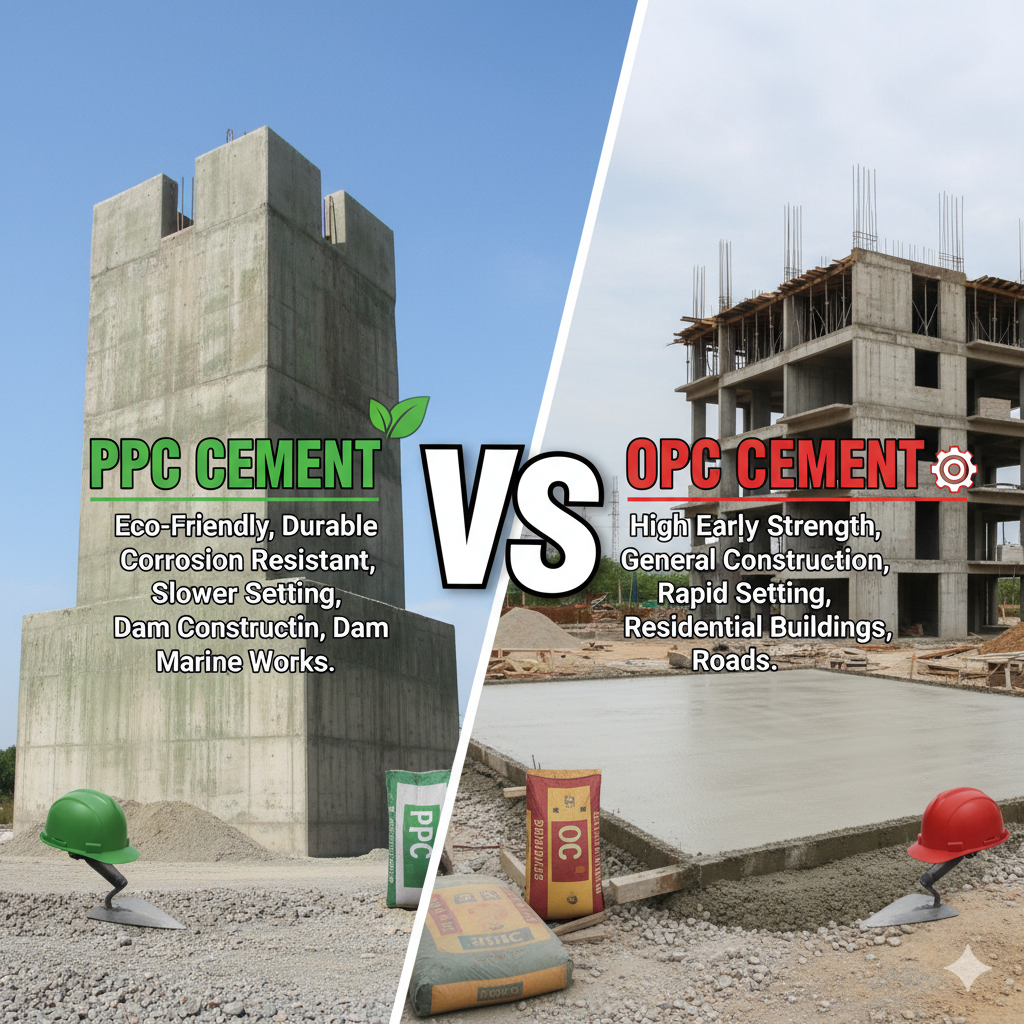
Cement is one of the most essential materials in the construction industry, and in Nepal, it plays a vital role in infrastructure development, housing projects, and commercial buildings. Among the different types of cement available, Ordinary Portland Cement (OPC) and Portland Pozzolana Cement (PPC) are the two most commonly used varieties. Although both serve the same basic purpose — to bind materials together in construction — they differ in composition, performance, application, and cost. Understanding the difference between PPC and OPC cement is important for builders, engineers, and consumers to choose the right type of cement according to their project needs.
1. Composition and Manufacturing Process for PPC and OPC Cement
The key difference between OPC and PPC lies in their composition.
OPC (Ordinary Portland Cement) is produced by grinding clinker (which is made from limestone and other raw materials) with a small amount of gypsum. It does not contain any additional materials. OPC comes mainly in three grades — 33, 43, and 53, which represent the compressive strength of the cement after 28 days.
PPC (Portland Pozzolana Cement), on the other hand, is manufactured by mixing clinker, gypsum, and pozzolanic materials such as fly ash, volcanic ash, or calcined clay. Pozzolanic materials have cementitious properties that enhance the long-term strength and durability of the cement. In Nepal, most cement factories have started producing PPC because of the availability of fly ash and its environmental benefits.
2. Strength and Setting Time
When it comes to strength, OPC provides faster strength development in the early days after application. It gains high compressive strength within the first 7 to 10 days, making it ideal for projects that require quick formwork removal or early load application.
PPC, however, gains strength gradually. Although its initial strength is lower than OPC, its long-term strength (after 28 days and beyond) is often equal to or even higher. The setting time of PPC is also slightly longer, which allows more time for mixing and placing — an advantage in large-scale concreting projects, especially in hot weather conditions commonly found in the Terai and mid-hill regions of Nepal.
3. Durability and Performance
Durability is one of the most important factors in cement selection, especially in the context of Nepal, where construction sites face varying climatic conditions — from high humidity in the plains to freezing temperatures in the mountains.
PPC cement provides higher durability compared to OPC because the pozzolanic materials in it react with the free lime released during hydration, reducing the chances of cracks, chemical attacks, and permeability. This makes PPC more resistant to moisture, sulfate attacks, and harmful chemicals, which is beneficial for construction near rivers, coastal regions, or areas with high groundwater levels.
OPC, while strong, is more prone to chemical attacks and cracks if not properly cured. Therefore, it is better suited for dry areas or projects where durability under harsh conditions is not the main concern.
4. Environmental Impact
Another major difference between PPC and OPC lies in their environmental impact. PPC is considered more eco-friendly because it uses industrial by-products like fly ash, reducing the need for clinker and thus lowering CO₂ emissions during production. With growing awareness of environmental conservation in Nepal’s construction industry, PPC has become the preferred choice among many local cement manufacturers.
OPC, on the other hand, requires more clinker production, which leads to higher carbon emissions and energy consumption. Hence, it is less sustainable in the long term.
5. Cost and Availability
In the Nepalese market, PPC cement is generally cheaper than OPC because of the lower cost of production due to the use of pozzolanic materials. Many local cement plants such as Shivam, Jagadamba, Arghakhanchi, and Hongshi Shivam produce large quantities of PPC, making it widely available across the country.
OPC cement is still produced and used, mainly for government infrastructure projects, precast concrete works, and high-strength constructions. However, it is relatively more expensive, and its demand has been decreasing in residential and general-purpose construction.
6. Applications in Nepal
The choice between PPC and OPC depends on the type of project:
- PPC Cement is ideal for residential buildings, plastering, flooring, bridges, dams, and general construction works where long-term durability and resistance to chemical attacks are needed.
- OPC Cement is suitable for industrial structures, high-rise buildings, precast works, and large-scale concrete projects where high early strength and quick setting are required.
In Nepal, due to its balance of price, performance, and availability, PPC cement has become more popular for most private and commercial projects, while OPC continues to be used for specialized structural works.
7. Final Comparison
| Property | OPC | PPC |
| Composition | Clinker + Gypsum | Clinker + Gypsum + Fly ash/pozzolana |
| Early Strength | High | Moderate |
| Long-Term Strength | High | Higher |
| Durability | Moderate | Excellent |
| Environmental Impact | High CO₂ emission | Eco-friendly |
| Cost | Higher | Lower |
| Preferred Use | Industrial & structural works | Residential & general works |
Conclusion
In summary, both PPC and OPC cements have their own advantages depending on the construction requirement. For most builders and consumers in Nepal, PPC offers better value due to its cost-effectiveness, long-term strength, and environmental benefits. However, OPC remains the better option for specialized structural and quick-setting applications. As Nepal continues to grow in infrastructure and urban development, understanding these differences helps in making smarter, more sustainable, and more economical construction choices.
More reads about Heavy Equipments