


Share This Article
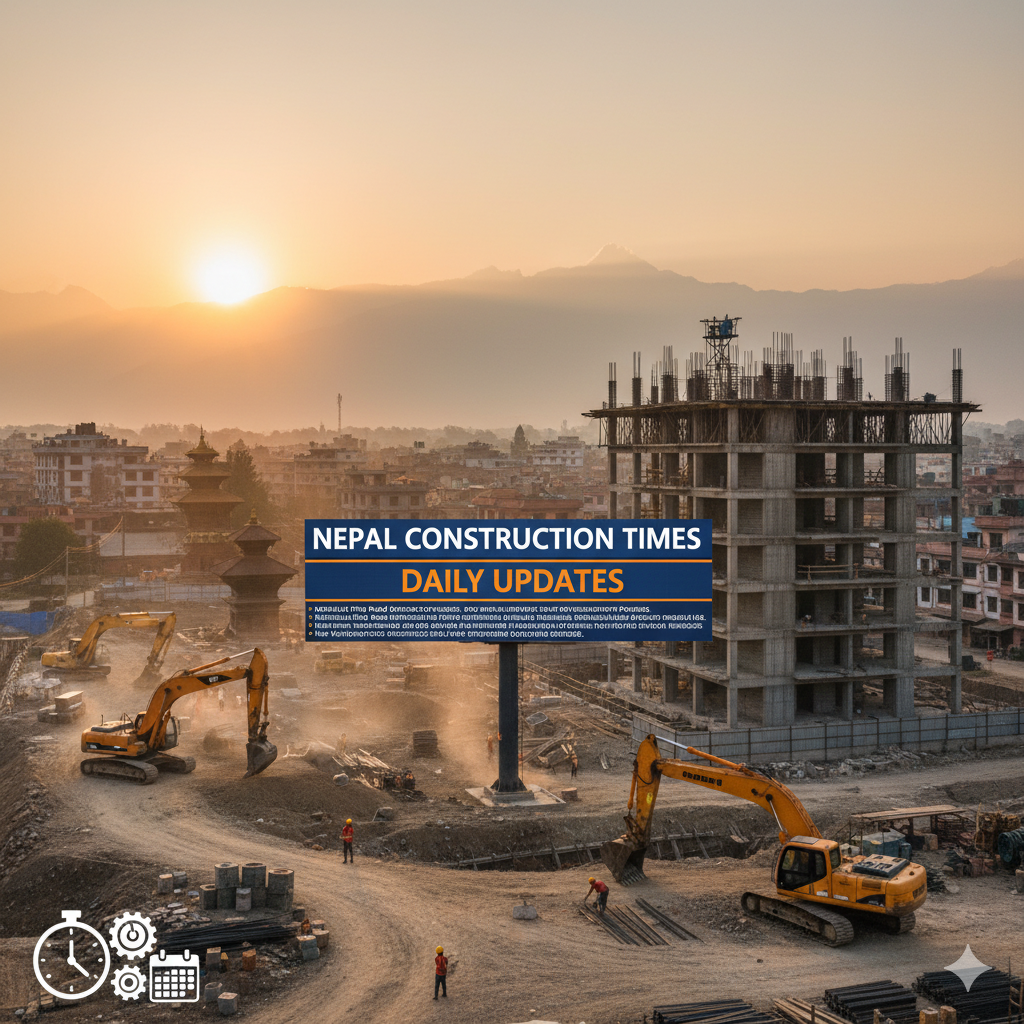
Kathmandu, Nepal — Nepal’s construction sector recorded notable developments today, marked by new industrial capacity, major infrastructure contracting, regulatory actions, and progress on national-pride hydropower projects.
Everest Fibre Cement Board Industry Begins Operations in Rautahat
A significant boost to domestic building material production came with the inauguration of the Everest Fibre Cement Board Industry in Rautahat. Established by IME Group with an investment of NPR 1.5 billion, the facility is Nepal’s first fully automated fibre-cement board manufacturing plant.
The factory will produce fire-resistant and weather-proof boards designed for wall partitions, exterior cladding, and modular building solutions. The enterprise has created around 200 local jobs, with over 40 percent positions filled by women from nearby communities. The plant is expected to reduce Nepal’s dependence on imported construction materials and contribute to faster, more efficient building timelines.
Government Issues NPR 4 Billion Contract for Karnali Corridor Upgrade
The Ministry of Physical Infrastructure and Transport awarded a major contract exceeding NPR 4 billion for the black-topping and upgrading of the Khulalu–Sallisalla section of the Karnali Corridor. The 50-km stretch forms a critical part of a national-pride project aimed at improving connectivity in remote mountain districts.
The contractor has been given a three-year deadline to complete the black-topping works. Once completed, the upgraded corridor is expected to boost trade, improve mobility, and stimulate economic activity in one of Nepal’s most underserved regions.
PPMO Blacklists Multiple Construction Companies
In a major enforcement action, the Public Procurement Monitoring Office (PPMO) blacklisted several construction firms for poor performance and failure to meet contractual obligations. Nine companies were newly blacklisted in the latest notice, while a prior announcement had barred 22 firms — including 19 construction companies — for up to three years.
The decision is seen as a strong signal of the government’s increasing emphasis on accountability and timely project delivery. Sector experts believe that such regulatory measures will improve the overall quality and reliability of public-sector construction.
Construction Trends for 2025 Highlight Sustainability and Technology
Industry analysts highlighted several trends that are shaping Nepal’s construction landscape heading into 2025. These include seismic-resilient designs, eco-friendly building materials, modular and prefabricated housing systems, and the growing use of digital tools such as drones and 3D modelling for project monitoring.
Architects are also incorporating modern designs that retain traditional Nepali cultural elements, supporting both aesthetics and cultural preservation.
Tanahun Hydropower Project Reports Steady Progress
The 140-MW Tanahun Hydropower Project in Rishing Rural Municipality continues to advance steadily. Engineers have already completed 73,000 m³ of concrete work on the main dam out of an estimated 900,000 m³. The powerhouse construction has reached 67 percent completion, while the transmission line section stands at 74 percent.
The project is scheduled for completion by mid-July 2026. Once operational, it will significantly strengthen Nepal’s renewable energy capacity and support industrial growth.
Overall Outlook
Today’s developments underscore a sector moving toward modernization, accountability, and increased self-reliance. Investments in manufacturing, ongoing national-level infrastructure projects, and technological adoption are shaping Nepal’s construction future. For suppliers, contractors, and service providers, the environment is increasingly competitive — with strong opportunities for those emphasizing quality, sustainability, and efficiency.
for more construction daily updates